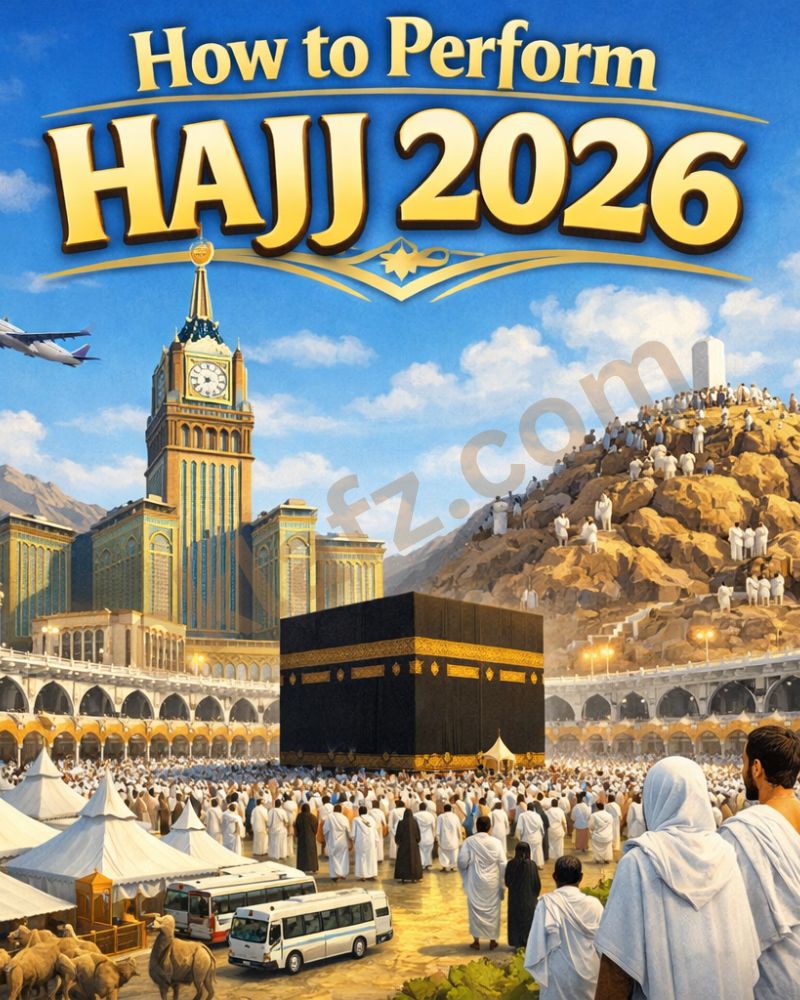
How to Perform Hajj 2026 Step by Step (Simple Guide)
Understanding How to Perform Hajj
Hajj is the sacred pilgrimage to Makkah that every eligible Muslim must perform at least once in their lifetime. It is one of the five pillars of Islam and is performed during the Islamic month of Dhul Hijjah.
For beginners, Hajj can seem complex, but when broken down step by step, it becomes easier to understand. Each ritual has deep spiritual meaning and follows the teachings of Prophet Ibrahim (AS) and Prophet Muhammad (PBUH).
This guide explains how to perform Hajj in a simple and structured way.
Step 1 – Entering Ihram (Preparation for Hajj)
The first step of Hajj is entering the state of Ihram. This is not just clothing—it is a spiritual condition.
Pilgrims wear simple white garments (for men, two unstitched cloths; for women, modest dress covering the body). Before entering Ihram, pilgrims make the intention (niyyah) for Hajj and recite the Talbiyah:
“Labbaik Allahumma Labbaik…”
From this point, certain actions become prohibited, such as arguing, cutting nails, or using perfume. This symbolizes purity, discipline, and equality before Allah.
Step 2 – Arrival at Mina (Day of Tarwiyah)
On 8th Dhul Hijjah, pilgrims travel to Mina, a tent city near Makkah.
Here, they spend the day in prayer, reflection, and preparation for the next important stages. It is a time of calm before the most significant day of Hajj.
Step 3 – Standing at Arafat (Most Important Day of Hajj)
On 9th Dhul Hijjah, pilgrims move to the plain of Arafat.
This is the most important part of Hajj. Pilgrims spend the entire day in prayer, asking for forgiveness, and making supplications to Allah.
The Prophet Muhammad (PBUH) said:
“Hajj is Arafah.”
This moment represents complete devotion and spiritual cleansing.
Step 4 – Muzdalifah (Night Under the Sky)
After sunset, pilgrims travel to Muzdalifah.
They pray Maghrib and Isha together and collect small stones for the next ritual. Many pilgrims sleep under the open sky, experiencing humility and simplicity.
Step 5 – Ramy al-Jamarat (Stoning the Devil)
On 10th Dhul Hijjah, pilgrims return to Mina and perform Ramy al-Jamarat.
They throw pebbles at three pillars, symbolizing rejection of evil and temptation. This act represents the story of Prophet Ibrahim (AS), who resisted Satan’s temptation.
Step 6 – Qurbani (Animal Sacrifice)
After stoning the devil, pilgrims perform Qurbani (sacrifice of an animal such as a goat, sheep, or cow).
This ritual honors the willingness of Prophet Ibrahim (AS) to sacrifice his son in obedience to Allah. The meat is distributed among the poor, family, and friends.
Step 7 – Shaving or Cutting Hair
After Qurbani, men usually shave their heads, while women cut a small portion of their hair.
This act symbolizes renewal, humility, and a fresh spiritual beginning.
Step 8 – Tawaf al-Ifadah (Circling the Kaaba)
Pilgrims return to Makkah and perform Tawaf al-Ifadah by circling the Kaaba seven times.
This is one of the essential pillars of Hajj and represents unity of believers worshipping one God.
Step 9 – Sa’i Between Safa and Marwah
Pilgrims walk between the hills of Safa and Marwah seven times, remembering the struggle of Hajar (AS), who searched for water for her son.
This ritual teaches patience, trust in Allah, and perseverance.
Step 10 – Final Days in Mina (Days of Tashreeq)
Pilgrims return to Mina for 11th, 12th, and sometimes 13th Dhul Hijjah.
They continue stoning the pillars daily and spend time in worship and remembrance of Allah.
لبیک کی صدا جب دل سے اٹھتی ہے
ہر خواہش دنیا کی خود ہی مٹتی ہے
سیاہ و سفید کا فرق پھر نہیں رہتا
ہر روح بس ایک ہی رب کو تکتی ہے
عرفات کی وہ دعا، وہ آنکھوں کا سمندر
ہر گناہ کی زنجیر وہیں ٹوٹتی ہے
Conclusion: The Spiritual Meaning of Hajj
Hajj is not just a physical journey—it is a complete transformation of the heart and soul. Every step teaches patience, humility, sacrifice, and devotion to Allah.
For beginners, understanding each stage makes the experience more meaningful and spiritually powerful.