
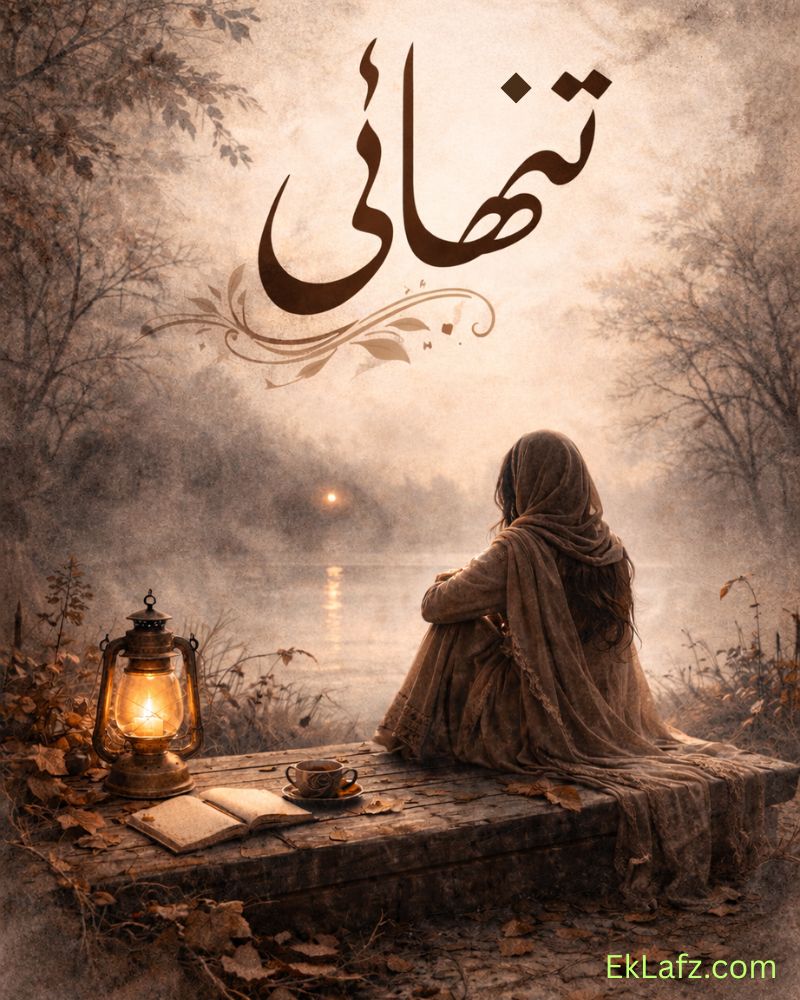
Loneliness Poetry in Urdu: An Emotional Journey Through Solitude
Loneliness is a universal emotion, experienced by people across time and culture. In Urdu poetry, it is often portrayed as an intense feeling that consumes the heart, a profound solitude that leads to self-reflection, pain, and a search for meaning. The beauty of loneliness in Urdu poetry lies in its capacity to convey not only despair but also strength, resilience, and growth through solitude.
Urdu poets, with their unparalleled mastery of words, have crafted verses that capture the varied shades of loneliness. Some speak of the aching void of separation, while others reflect on the stillness and quiet that come with solitude. In this blog, we will explore the theme of loneliness in Urdu poetry through the words of renowned poets, who have managed to transform this deep feeling into timeless art.
1. Mirza Ghalib: The Poet of Deep Solitude
When discussing loneliness in Urdu poetry, the name Mirza Ghalib immediately comes to mind. Known for his deep, reflective verses, Ghalib’s poetry frequently explores themes of separation and the sorrow of solitude. His work reflects not only his personal isolation but also the existential loneliness of the human condition.
In his famous ghazals, Ghalib paints a picture of loneliness that is both philosophical and intensely personal. Here’s one of his notable verses on loneliness:
“Dil hi to hai na sang-o-khisht, dard se bhar na aaye kyun,
Tere ishq mein, aur jeene ki tamanna kaise na ho.”
(The heart is not made of stone or brick, why shouldn’t it be filled with pain?
In your love, how can there not be a desire to live?)
Ghalib speaks of loneliness not as an isolated experience but as a deep, emotional connection to love, where even the pain of separation becomes an integral part of existence. For Ghalib, loneliness is a powerful force that connects the heart to both pain and love.
2. Faiz Ahmed Faiz: Loneliness in the Fight for Justice
Faiz Ahmed Faiz, one of the most prominent names in Urdu literature, is known for his revolutionary themes, but his poetry also encompasses the poignant sadness of solitude. Faiz’s loneliness often emerges in the context of social struggle, love, and separation. His verses reflect the anguish of a lover and a revolutionary separated by time and circumstance.
One of his beautiful verses on loneliness is:
“Raat bhar ka hai mehman andhera,
Chandni se bhi hai zyada dard ka gham.”
(The darkness is a guest for the night,
But the pain is deeper than the moonlight.)
Faiz captures the contrast of loneliness through his imagery of light and darkness, symbolizing how solitude can simultaneously illuminate and deepen emotional pain. For Faiz, loneliness is not just the absence of company; it’s an internal struggle that shapes one’s view of the world.
3. Ahmed Faraz: The Lonely Heart’s Lament
Ahmed Faraz is another Urdu poet whose verses are filled with the ache of loneliness. Known for his romantic poetry, Faraz’s work often captures the longing for a lost love or the pain of being separated from someone dear. His loneliness is not just about physical absence but about the emotional void that remains in the heart.
A famous line from Faraz encapsulates his perspective on loneliness:
“Kuch toh hai jo hum mein baat karte hain,
Agar na ho toh yeh bhi khali ho jata hai.”
(There is something that we speak to ourselves,
If it weren’t for that, even this would feel empty.)
For Faraz, loneliness is tied to the sense of self and introspection. It’s a feeling that arises from being alone in one’s thoughts, the overwhelming silence that takes over when there is no one else to converse with.
4. Allama Iqbal: Solitude as Self-Discovery
Unlike some of the poets we’ve discussed, Allama Iqbal viewed loneliness not merely as a source of sadness but as a vital part of personal growth. In his poetry, solitude becomes a space for self-reflection and spiritual awakening. Iqbal believed that loneliness could lead one to greater self-awareness, urging the reader to embrace it as a time for inner exploration and renewal.
A powerful excerpt from his poetry on loneliness is:
“Khudi ko kar buland itna,
Ke har taqdeer se pehle,
Khuda bande se khud poochay,
Bata teri raza kya hai?”
(Raise your self-esteem so high,
That before every fate,
God asks you, what is it that you desire?)
While this verse doesn’t directly address loneliness, it encourages an individual to find strength in solitude and make the most of the time spent with oneself. For Iqbal, loneliness was not something to be feared but a necessary phase in the journey of self-realization.
5. Mir Taqi Mir: The Silent Solitude of the Heart
Mir Taqi Mir, a poet from the classical tradition of Urdu poetry, often explored the themes of isolation and melancholy in his work. His poetry is filled with profound sadness and longing, often touching upon the loneliness that comes from a broken heart.
One of his poignant verses on loneliness reads:
“Agar che hai nasha-e-ishq,
Hum bhi to khumari mein hain.”
(Though love brings intoxication,
I too am in its state of drunkenness.)
Mir’s loneliness is tied to the intoxication of love and loss. He beautifully conveys how loneliness can come from both the sweetness of love and its painful absence. His poetry reflects the silent solitude that lingers within a heart that is separated from the one it loves.
6. Ahmad Nadeem Qasmi: The Poignancy of Solitary Moments
Another important figure in Urdu poetry, Ahmad Nadeem Qasmi, offers a unique perspective on loneliness. His poetry often explores the pain of being alone but also the subtle beauty found in solitude. For Qasmi, loneliness is not only about emotional suffering but also a state that allows one to see life in its simplest, most raw form.
A beautiful line from his poetry on loneliness is:
“Akelepan mein bhi kuch khaas baat hai,
Jise samajh na paaye, woh hai zaroori.”
(There’s something special about being alone,
Something that cannot be understood, yet it is essential.)
Qasmi’s work highlights the complex nature of loneliness, showing that it is not always a curse but a part of the human experience that leads to deeper understanding.
Conclusion
Loneliness in Urdu poetry is much more than an isolated feeling of being alone. It is an emotion that has been explored through various lenses – from deep emotional longing to a path toward self-discovery and inner strength. Poets like Ghalib, Faiz, Faraz, Iqbal, Mir, and Qasmi have beautifully captured the essence of loneliness, transforming it into poetry that resonates across generations.
Through their words, we come to understand that loneliness is not just about the absence of people; it is about finding oneself, navigating the complexities of emotions, and ultimately learning to embrace solitude as a part of the human journey. Each verse invites us to reflect on our own moments of solitude and see them not just as times of sorrow, but as essential steps toward understanding and growth.
Related Poetry:
“Akelepan ki raahon mein, ek zindagi ka safar tha”
“Tanhaaiyon mein kho gaya tha mein”
“Meri rooh ki khamoshi mein, ek aawaaz thi”
These lines embody the diverse emotional spectrum of loneliness, capturing both its pain and its capacity for profound self-reflection.